

The Transatlantic Slave Trade
The enslavement of human beings occupies a painful and tragic space in world history. Denying a person freedom, autonomy, and life represents the worst kind of abuse of human rights.
Many societies tolerated and condoned human slavery for centuries. But in the 15th century, an expanded and terrifying new era of enslavement emerged that has had a profound and devastating impact on human history.
The abduction, abuse, and enslavement of Africans by Europeans for nearly five centuries dramatically altered the global landscape and created a legacy of suffering and bigotry that can still be seen today.
After discovering lands that had been occupied by Indigenous people for centuries, European powers sent ships and armed militia to exploit these new lands for wealth and profit starting in the 1400s. In territories we now call “the Americas,” gold, sugar, tobacco, and extraordinary natural resources were viewed as opportunities to gain power and influence for Portugal, Spain, Great Britain, France, Italy, Germany, and Scandinavian nations.
Europeans first sought to enslave the Indigenous people who occupied these lands to create wealth for foreign powers, resulting in a catastrophic genocide. Disease, famine, and conflict killed millions of Native people within a relatively short period of time.
Determined to extract wealth from these distant lands, European powers sought labor from Africa, launching a tragic era of kidnapping, abduction, and trafficking that resulted in the enslavement of millions of African people.
Between 1501 and 1867, nearly 13 million African people were kidnapped, forced onto European and American ships, and trafficked across the Atlantic Ocean to be enslaved, abused, and forever separated from their homes, families, ancestors, and cultures.
The Transatlantic Slave Trade represents one of the most violent, traumatizing, and horrific eras in world history. Nearly two million people died during the barbaric Middle Passage across the ocean. The African continent was left destabilized and vulnerable to conquest and violence for centuries. The Americas became a place where race and color created a caste system defined by inequality and abuse.
In the “colonies” that became the United States, slavery took on uniquely appalling features. From New England to Texas, Black people were dehumanized and abused while they were enslaved and denied basic freedoms. Legal and political systems were created to codify racial hierarchy and ensure white supremacy. Slavery became permanent and hereditary, defined by race-based ideologies that insisted on racial subordination of Black people for decades after the formal abolition of slavery.
Millions of Black people born in the U.S. were subjected to abuse, violence, and forced labor despite the young nation’s identity as a constitutional democracy founded on the belief that “all men are created equal.”
Racialized slavery was ignored, defended, or accommodated by leaders while the new nation gained extraordinary wealth and influence in the global economy based on the forced labor of enslaved Black people.
The economic legacy of the Transatlantic Slave Trade—including generational wealth and the founding of industries that continue to thrive today—is not well understood.
New England, Boston, New York City, the Mid-Atlantic, Virginia, Richmond, the Carolinas, Charleston, Savannah, the Deep South, and New Orleans were shaped by the trafficking of African people, but few have acknowledged their history of enslavement or its legacy.
This report is a first step in helping people understand the scope and scale of the devastation created by slavery in America and the Transatlantic Slave Trade’s influence on a range of contemporary issues. It seeks to initiate more meaningful and truthful conversations about the history of slavery in America and how we can effectively address its legacy.
At a time when some believe we should avoid any discourse about our history that is uncomfortable, we believe that an honest engagement with our past is essential if we are to create a healthy and just future.
“History, despite its wrenching pain, cannot be unlived, but if faced with courage, need not be lived again.”
Origins
The enslavement of people has been a part of human history for centuries. Slavery and human bondage has taken many forms, including enslaving people as prisoners of war or due to their beliefs, but the permanent, hereditary enslavement based on race later adopted in the U.S. was rare before the 15th century.
Many attributes of slavery began to change when European settlers intent on colonizing the Americas used violence and military power to compel forced labor from enslaved people. Indigenous people became the first victims of forced labor and enslavement at the hands of Europeans in the Americas. However, millions of Indigenous people died from disease, famine, war, and harsh labor conditions in the decades that followed.
Committed to extracting profit from their colonies in the Americas, European powers turned to the African continent. To meet their ever-growing need for labor, they initiated a massive global undertaking that relied on abduction, human trafficking, and racializing enslavement at a scale without precedent in human history. Never before had millions of people been kidnapped and trafficked over such a great distance.
The permanent displacement of 12.5 million African people to a foreign land, with no possibility of ever returning, created an enduring legacy and shaped challenges that remain with us today.
The European Influence on Africa
Europe had no contact with Sub-Saharan Africa before the Portuguese, seeking wealth and gold, sailed down the western coast of Africa and reached the Gold Coast (modern-day Ghana) in 1471. Initially focused on obtaining gold, Portugal established trading relationships and built El Mina Fort to protect its interests in the gold trade.
The convergence of European powers in Sub-Saharan Africa set in motion a devastating process that fused sophisticated labor exploitation, international commerce, mass enslavement, and an elaborate race-based ideology to create the Transatlantic Slave Trade.
Over the following decades, the Spanish, English, French, Dutch, Danish, and Swedes began to make contact with Sub-Saharan Africa as well. Portugal soon converted El Mina into a prison for holding kidnapped Africans, and European traffickers built castles, barracoons, and forts on the African coast to support the forced enslavement of abducted Africans.
German and Italian merchants and bankers who did not personally traffic kidnapped Africans nonetheless provided essential funding and insurance to develop the Transatlantic Slave Trade and plantation economy. Italian merchants were essential in the effort to extend the sugar plantation system to the Atlantic Islands off the west coast of Africa, like São Tomé, and financial capital from Genoa was instrumental in expanding Portugal’s ability to traffic Africans.
By the 1600s, every major European power had established trading relationships with Sub-Saharan Africa and was participating in the transportation of kidnapped Africans to the Americas in some way. During this time period, several thousand Africans were kidnapped and trafficked to mainland Europe and the Americas, but the volume of human trafficking soon escalated to horrific proportions.
Led again by the Portuguese, European powers began to occupy the Americas in the 1500s. In the 16th and 17th centuries, using land stolen from Indigenous populations in the Americas, Europeans established plantations that relied on enslaved labor to mass produce goods (primarily sugar cane) for trading and sale.
The cultivation of sugar for mass consumption became a driving force in the growing trafficking of human beings from Africa.
Europeans initially relied on Indigenous people to supply this labor. But mass killings and disease decimated Indigenous populations in what historian David Brion Davis called “the greatest known population loss in human history.”
The Indigenous population in Mexico plummeted by nearly 90% in 75 years. In Hispaniola (modern-day Haiti and Dominican Republic), the population of Arawak and Taino people fell from between 300,000 and 500,000 in 1492 to fewer than 500 people by 1542, just five decades later. Without Indigenous workers, plantation owners in the Americas grew desperate for a new source of exploited labor.
Driven by the desire for wealth, these European powers shifted from acquiring gold and other goods in Sub-Saharan Africa to trafficking in human beings. Over the following centuries, Europeans demanded that millions of Africans be trafficked to work on plantations and in other businesses in the Americas.
Slavery had existed in Africa prior to this point, but this new commodification of human beings by European powers was entirely unique and it drastically changed the African concept of enslavement.
Although some African officials and merchants acquired wealth through the export of millions of people, the Transatlantic Slave Trade devastated and de-stabilized societies and economies across Africa. The scale of disruption and violence contributed to long-term conflict and violence on the continent while European powers were able to amass massive financial benefits and global power from this dehumanizing trade.
The Iberian powers of Spain and Portugal and their colonies in Uruguay and Brazil were responsible for trafficking 99% of the nearly 630,000 kidnapped Africans trafficked from 1501 to 1625.
Over the next 240 years, England, France, the Netherlands, Scandinavia, the Baltic States, and their colonies joined the Iberians in actively trafficking Africans. Almost 12 million kidnapped Africans were trafficked from 1625 to 1867. Ships from Portugal and its colony Brazil alone were responsible for trafficking 5,849,300 kidnapped Africans during this time period.
Ships originating in Great Britain were responsible for trafficking more than a quarter of all people taken from Africa from 1501 to 1867. From 1726 to 1800, British ships were the leading traffickers of kidnapped Africans, responsible for taking more than two million people from Africa.
From 1626 to 1867, ships from North America were responsible for trafficking at least 305,000 captured people from Africa. In the two years before the U.S. legally ended the international slave trade in 1808, a quarter of all trafficked Africans were carried in ships that flew the U.S. flag.
Rhode Island’s ports combined to organize voyages responsible for trafficking at least 111,000 kidnapped Africans, making it one of the 15 largest originating ports in the world.
The Barbarity of the Middle Passage
The horrific conditions of the Middle Passage meant that of more than 12.5 million Africans kidnapped and trafficked through the Transatlantic Slave Trade, only 10.7 million survived the journey.
Eighty percent of the people who embarked for the Americas between 1500 and 1820 were kidnapped Africans, who far outnumbered European immigrants.
Almost two million Africans died during the Middle Passage—nearly one million more than all of the Americans who have died in every war fought since 1775 combined.
Numbers like this can help to quantify the scope of the harm, but they fail to detail the horrific and torturous experience of those who perished and the trauma that 10.7 million Africans who survived the weeks-long journey carried with them.
An exhibit at EJI’s Legacy Museum in Montgomery, Alabama, features more than 200 sculptures by Ghanaian sculptor Kwame Akoto-Bamfo memorializing those who died during the Middle Passage.
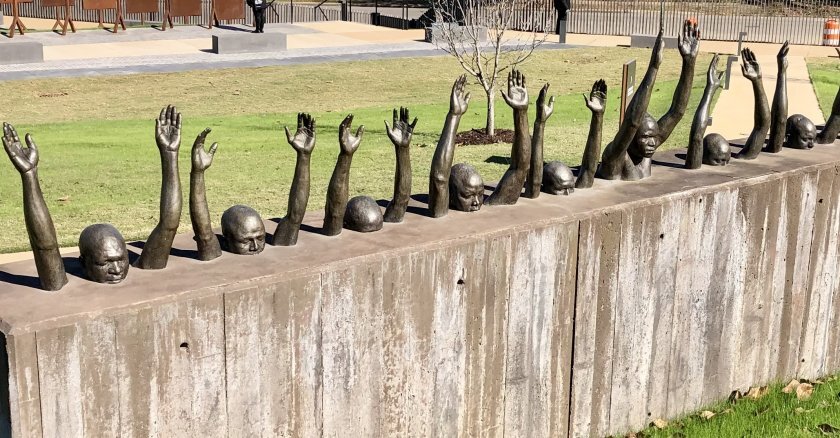
Some enslaved people were taken from the coast of West Africa and sold to European slave traders. For most captives the experience of Transatlantic trafficking began weeks, months, or even years before they ever saw the coast.
Driven by the increasing external demand from white enslavers and traders, African kidnappers traveled inland and kidnapped people from their villages and towns.
In the 18th century, 70% of Africans trafficked in the Transatlantic Slave Trade were free people who had been “snatched from their homes and communities.” They were most often forced to walk, bound together in a coffle, for dozens or even hundreds of miles until they reached the coast.
At the coast, kidnapped Africans were forced into barracoons, slave pens, and dungeons within prison castles to await the ships that would take them across the Atlantic. Kidnapped Africans were forced to board slave trading ships that stayed docked—sometimes for months—until they had loaded enough human cargo to make the passage sufficiently profitable for the enslavers.
Records do not establish an exact death toll, but scholars estimate the mortality rate among those confined in barracoons and on board docked trading ships “equaled that of Europe’s fourteenth-century Black Death,” which claimed at least 40% of Europe’s population.
Countless Africans perished before they even began the Middle Passage.
Ottobah Cugoano was a young child when he was “snatched away from [his] native country, with about eighteen or twenty more boys and girls.”
The kidnappers brandished “pistols and cutlasses” and threatened to kill the children if they did not come with them. For Ottobah and millions like him, the trauma of familial separation would be inflicted repeatedly in the Transatlantic Slave Trade. Ottobah’s “hopes of returning home again were all over” as he was marched to the coast and placed in a prison until a white slave trader’s ship arrived three days later.
“[I]t was a most horrible scene,” Ottobah later recounted.
“[T]here was nothing to be heard but the rattling of chains, smacking of whips, and the groans and cries of our fellow-men. Some would not stir from the ground, when they were lashed and beat in the most horrible manner.”
“Narrative of the Enslavement of Ottobah Cugoano,” 124.
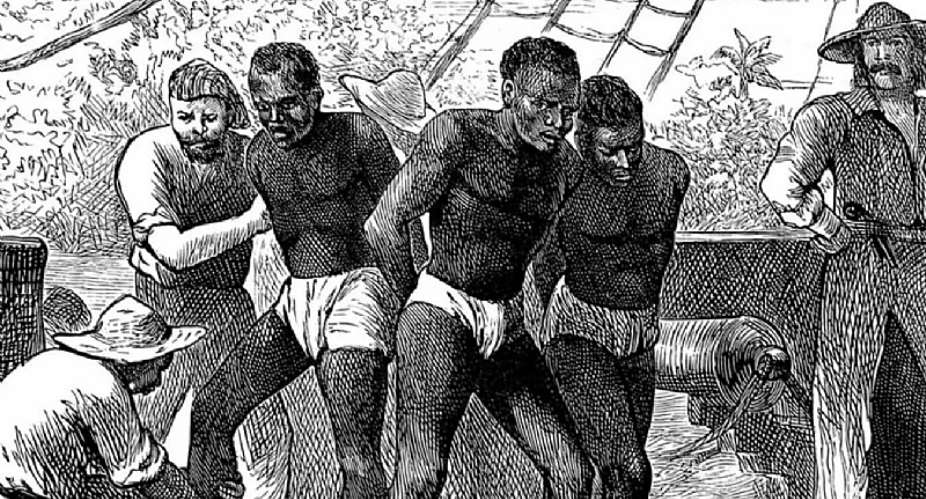
African captives were forced to undergo invasive and dehumanizing examinations before they boarded enslavers’ ships. Women, men, and children were stripped naked, prodded, and molested to determine if they were “prime slaves” capable of performing hard labor and having children.
Traders invasively groped the breasts, buttocks, and vaginal areas of women and young girls, allegedly to assess their childbearing ability. Men and boys were similarly molested around the groin, scrotum, and anus.40 One white trafficker later testified the process was similar to what he would do to “a horse in this country, if I was about to purchase him.”
Captives were then assigned a number and loaded onto ships, separated by gender and tightly packed into the holds under conditions that were noxious and extreme.
Men were typically “locked spoonways” together, naked and forced to lie in urine, feces, blood, and mucus, with little to no fresh air. Alexander Falconbridge, a white surgeon who participated in the slave trade, later testified that captives “had not so much room as a man in his coffin, neither in length or breadth, and it was impossible for them to turn or shift with any degree or ease.
Trafficked Africans were forced to lie chained and manacled for weeks during the journey, unable to stretch out or stand except during limited time on deck. The foul conditions were a breeding ground for disease and vermin; some captives suffocated from the lack of air below deck. On some ships, the mortality rate was as high as 33%.
About 15% of kidnapped Africans—nearly two million people—died during the Middle Passage.
African women and girls suffered similarly horrific conditions in the hold—and they were uniquely terrorized by the crew. Forced to be naked and segregated from the men, they lived in constant fear of being raped or assaulted by white sailors, who subjected them to sexual violence and flogged those who resisted.
Sexual assault of African women was so commonplace that Alexander Falconbridge later testified that sailors were “permitted to indulge their passions among them at pleasure.” Young girls were similarly subjected to violence. One surviving account details the experience of “a little girl of eight to ten years” who was repeatedly raped by a ship’s captain over three consecutive nights.
Some African women faced a second level of terror—the inability to protect their small children who were brought on board with them or born during the voyage.50
Many African women were forcibly separated from their infants when they were kidnapped from their homes or when they were sold to white traffickers but some women carried small infants with them.
Babies were of little value in the market across the Atlantic, and so abusive sailors used them to manipulate, control, and terrorize their mothers. One account details a sailor who “tore the child from the mother, and threw it into the sea” when the newborn would not stop crying.
Enslaved women and young girls were systematically subjected to sexual abuse and violence by traffickers and enslavers.
Another account from a white trafficker reports that a woman and her nine-month-old were purchased and placed onboard a ship. The baby “would not eat,” so the captain “flogged him with a cat o’ nine tails” in front of his mother and other captives on the ship.53
When he noticed that the baby’s feet were swollen, the captain ordered his crew to submerge the baby’s legs in boiling water, causing “the skin and nails [to come] off.”54
The baby still would not eat, so the captain flogged him at each meal time for several days before finally “[tying] a log of mango, either eighteen or twenty inches long, and about twelve or thirteen pound weight, to the child by a string round its neck,” beating the baby again, and dropping the baby to the ground, killing him.55
His mother—powerless to save her baby—was beaten until she agreed to throw her baby’s body overboard. This act of terror was intentionally committed in view of other captives to strike fear and maintain control.56
Cruelty and terrorism were common on trafficking vessels operated by Europeans. Sailors inflicted brutal punishments for even minor offenses as a reminder of their control.57 One account from a white sailor reported that eight to 10 captives were brought to the top deck one night “for making a little noise in the rooms.”58
Sailors were then ordered to “tie them up to the booms [horizontal poles extending from the base of the mast], flog them very severely with a wire cat [a whip with multiple tails of wire], and afterwards clap the thumb-screws upon them, and leave them in that situation till morning.”
The same sailor said the use of the thumb-screws—a device that crushed fingers via pressure—was so violent and harmful that it resulted in “fevers” and even death on occasion.
For more serious offenses, sailors inflicted even greater violence. One captive woman who was accused of aiding (but not actively participating) in an attempted revolt against the kidnappers, was strung up on the deck by her thumbs in view of the other captives. As a warning to them, she was flogged and knifed to death.
The threat of being flogged with a cat o’ nine tails [a multi-tailed whip with lashes often tipped with metal or barbs] or placed in the thumb-screws hung over each captive. Consuming more than their meager allotment of food could lead to whipping and torture. Captives were forced onto the deck and made to “dance” for exercise under threat of flogging.
As one eyewitness observed, “Even those who had the flux, scurvy, and such edematous swelling in their legs, as made it painful to them to move at all, were compelled to dance by the cat.”
Failure to eat one’s rations likewise resulted in abuse, whipping, or torture in the thumb-screws until the kidnapped African agreed to eat.
These excruciating conditions lasted for weeks and sometimes for months. A typical voyage took five or six weeks; some took two or three months. Longer voyages led to higher mortality rates among the kidnapped Africans on board.
When the ships landed in ports across North and South America, the kidnapped Africans who survived the Middle Passage were subjected to a renewed round of examinations and molestation by enslavers before they were sold again and forced to do hard labor that often resulted in their untimely deaths.
Around 80% of kidnapped Africans transported across the Middle Passage were forced to work on sugar plantations under incredibly dangerous conditions that led to high mortality rates.
Slavery in the Americas
Of the enslaved men, women, and children who survived the Middle Passage, approximately 90% arrived in the Caribbean or South America.
The Portuguese, Spanish, French, British, and Dutch controlled slavery in the Americas, and each followed different political, legal, and cultural practices.
Due in part to these differences, the evolution of slavery in the Americas varied across the region, as did the social construction of race and racial hierarchy.
There is no value in comparing the relative “harshness” of slavery across the Americas; the brutality and inhumanity of slavery was universal. Moreover, conditions in the South American and Caribbean colonies were horrific—the vast majority of enslaved people in these colonies worked on sugar plantations, which were notoriously harsh environments.
Work on these plantations was “life-consuming,” with long hours of gang labor—often beginning at 5 a.m. and working until dusk—and extremely hazardous work conditions. Plantations in Brazil had higher mortality rates and lower life expectancies than plantations in the U.S
Factors specific to each European power and its colonies distinguished the experiences of enslaved men and women across the Americas. In the North American colonies and later the U.S., white people were in the majority everywhere except in South Carolina and Mississippi. But in South America and the Caribbean, nonwhite people regularly exceeded 80% of the population.
When the Haitian revolution started in August 1791, white Europeans made up just 7% of the population and there were roughly as many free people of color as there were Europeans. Iberian control in South America was challenged by the growing number of enslaved people, who often demanded their freedom in exchange for fighting Indigenous people who resisted European colonizers. In these colonies, the threat of rebellion against the minority white population was critical in shaping society.
In contrast, the exceptionally large white majority in North America meant that rebellions by enslaved people, while far more common than most people realize today, did not represent as great a threat to white rule. As a result, while the fear of rebellions profoundly shaped the legal and cultural landscape of North America, British colonists rarely were forced to make legal or political concessions to enslaved people.
Geographic and demographic variations also distinguished how race and racial hierarchy developed in North America.
For example, during the first century of Portuguese colonization in Brazil, there were very few Portuguese or white women, which meant that despite anti-miscegenation laws passed in Portugal, there were high rates of interracial sex between white men and women of African descent in Brazil.
By 1822, more than 70% of Brazil’s population “consisted of blacks or mulattoes, slaves, liberto, and free” people of color.
Today, Brazil is home to the largest population of African descendants outside the African continent.
In most South American and Caribbean colonies, large populations of free people of color emerged and “elaborate human taxonomies” based on race and caste were developed.
A different racial hierarchy evolved in North America, where free people of color represented a very small fraction of the population. There, a single, rigid color line separated two racial groups: Black and white.
Finally, the legal codes that governed enslaved peoples’ lives—laws on manumission, the status of enslaved people as humans or property, marriage and family formation, and racial classification—varied by region and the colony. These laws demonstrate the complex racial hierarchies in the region.
Throughout the region, racial discrimination was codified in laws that barred free Black people from “hold[ing] political office, practic[ing] prestigious professions (public notary, lawyer, surgeon, pharmacist, smelter) or enjoy[ing] equal social status with whites.”
But in 1795, the Spanish Crown made it possible to purchase whiteness—people of color with mixed ancestry could “apply and pay for a decree” that converted their legal status to white. These laws sparked “vigorous and serious debate concerning the civil rights of those of mixed descent” in some countries.
The 1812 constitution of the Spanish Empire further expanded opportunities for mixed-race citizens, including desegregating universities a century and a half before the U.S.
In French colonies, the “Code Noir” passed by Louis XIV in 1685 shaped an entirely different landscape. The code mandated execution for an enslaved person who struck their enslaver,102 but it also granted free people of color the same rights as any “persons born free,”103 prohibited enslaved parents from being sold separately from their children,104 deemed free the child of a free woman and an enslaved man of color,105 and fined an enslaver who had a child with an enslaved woman unless he married and freed the woman and her child.106
Critically, under the Code Noir, free people of color dramatically increased their numbers. In Louisiana, which spent decades under French control, there were 18,647 free Black people by 1860—almost 3,000 more than in South Carolina, Georgia, Alabama, and Mississippi combined.
The British and their descendants in North America made race the central aspect of laws governing slavery and the lives of enslaved and free Black Americans. A stark “black-white binary” reflected and reinforced the centrality of race in all areas of American life.
As a result, while the particular experience of slavery depended on region and time period, enslavement in the U.S. became a rigid, racialized caste system that inexorably tied enslavement to race.
The system of enslavement that emerged in North America was legitimated by an elaborate set of laws enforced through terror and violence and used to justify and codify the permanent, hereditary, and unending slavery of Black people for generations.
From the first arrival of kidnapped Africans in the English colonies that would become the United States, the institution of enslavement was foundational to the economy of every major city on the Eastern Seaboard.
The history of these regions cannot be fully understood without acknowledging the role enslavement played in creating their economies, laws, and political and cultural institutions and the innumerable ways this legacy shapes these communities today.
UN votes to recognise enslavement of Africans as ‘gravest crime against humanity’
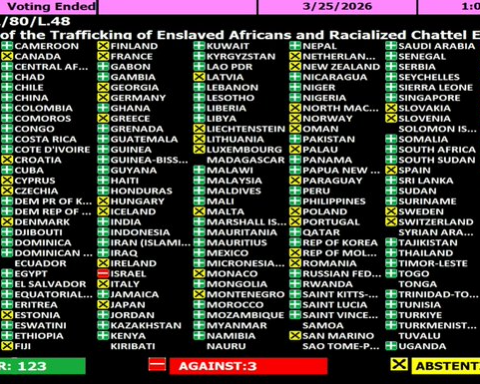
The United Nations General Assembly has voted to recognise the enslavement of Africans during the transatlantic slave trade as “the gravest crime against humanity”, a move advocates hope will pave the way for healing and justice.
The resolution – proposed by Ghana – called for this designation, while also urging UN member states to consider apologising for the slave trade and contributing to a reparations fund. It does not mention a specific amount of money.
The proposal was adopted with 123 votes in favour and three against – the United States, Israel and Argentina.
Fifty-two countries abstained, including the United Kingdom and European Union member states.
Countries like the UK have long rejected calls to pay reparations, saying today’s institutions cannot be held responsible for past wrongs.
Unlike UN Security Council resolutions, those from the General Assembly are not legally binding, though they carry the weight of global opinion.
“Let it be recorded that when history beckoned, we did what was right for the memory of the millions who suffered the indignity of the slave trade and those who continue to suffer racial discrimination,” Ghana’s President John Mahama told the assembly ahead of the vote.
”The adoption of this resolution serves as a safeguard against forgetting. It also challenges the enduring scars of slavery,” he said.
Earlier, his foreign minister, Samuel Okudzeto Ablakwa, told the BBC’s Newsday programme: “We are demanding compensation – and let us be clear, African leaders are not asking for money for themselves.
“We want justice for the victims and causes to be supported, educational and endowment funds, skills training funds.”
The campaign for reparations has gained significant momentum in recent years – “reparatory justice” was the African Union’s official theme for 2025 and Commonwealth leaders have jointly called for dialogue on the matter.
Ablakwa also said that, with the resolution, Ghana was not ranking its pain above anyone else’s, but simply documenting a historical fact.
Between 1500 and 1800, around 12-15 million people were captured in Africa and taken to the Americas where they were forced to work as slaves. It is estimated that over two million people died on the journey.
What form could reparations for slavery take?
The resolution, backed by the African Union and the Caribbean Community, states that the consequences of slavery persist in the form of racial inequalities and underdevelopment “affecting Africans and people of African descent in all parts of the world”.
Ablakwa told the BBC: “Many generations continue to suffer the exclusion, the racism because of the transatlantic slave trade which has left millions separated from the continent and impoverished.”
Ahead of the vote, speaker after speaker expressed similar views.
The UK, one of the major powers involved in the transatlantic slave trade, said it recognised the untold harm and misery that had been caused to millions of people over many decades.
But its ambassador to the UN, James Kariuki, told the assembly in his speech that the resolution was problematic in terms of its wording and international law.
“No single set of atrocities should be regarded as more or less significant than another,” he said.
The US’s ambassador to the UN made similar points during his speech, saying his country “does not recognise a legal right to reparations for historical wrongs that were not illegal under international law at the time they occurred”.
In addition, Dan Negrea said the US objected to the “cynical usage of historical wrongs as a leverage point to reallocate modern resources to people and nations who are distantly related to the historical victims”.
Ghana, one of the main gateways for the transatlantic slave trade, has long been a leading advocate for reparations.
Forts, where tens of thousands of enslaved Africans were once held under inhuman conditions, remain standing along the West African country’s coast.
As well as the “legal problems” around reparations, the US ambassador said the resolution was unclear as “to whom the recipients of ‘reparatory justice’ would be”.
Negrea also responded to Mahama’s earlier criticism of Donald Trump’s administration for “normalising the erasure of black history”.
Since returning to power, the US president has targeted American cultural and historical institutions for promoting what he calls “anti-American ideology”.
Trump’s orders have led to moves such as the restoration of Confederate statues and an attempt to dismantle a slavery exhibit in Philadelphia.
“These policies are becoming a template for other governments as well as some private institutions,” Mahama had said on Tuesday.
But Negrea said President Trump had done “more for black Americans than any other president”.
“He is working around the clock to deliver for them and make our country greater than ever,” he said.
The resolution also calls for cultural artefacts stolen during the colonial era to be returned to their countries of origin.
“We want a return of all those looted artefacts, which represent our heritage, our culture and our spiritual significance,” Ablakwa said.
“All those artefacts looted for many centuries into the colonial era ought to be returned.”
History never dies. It only grows into new heights and challenges which humanity has to be ready to face.
And now centuries of African Slavery is on the world map.
We are ready for that war now more than ever before.
Read: America then and now.