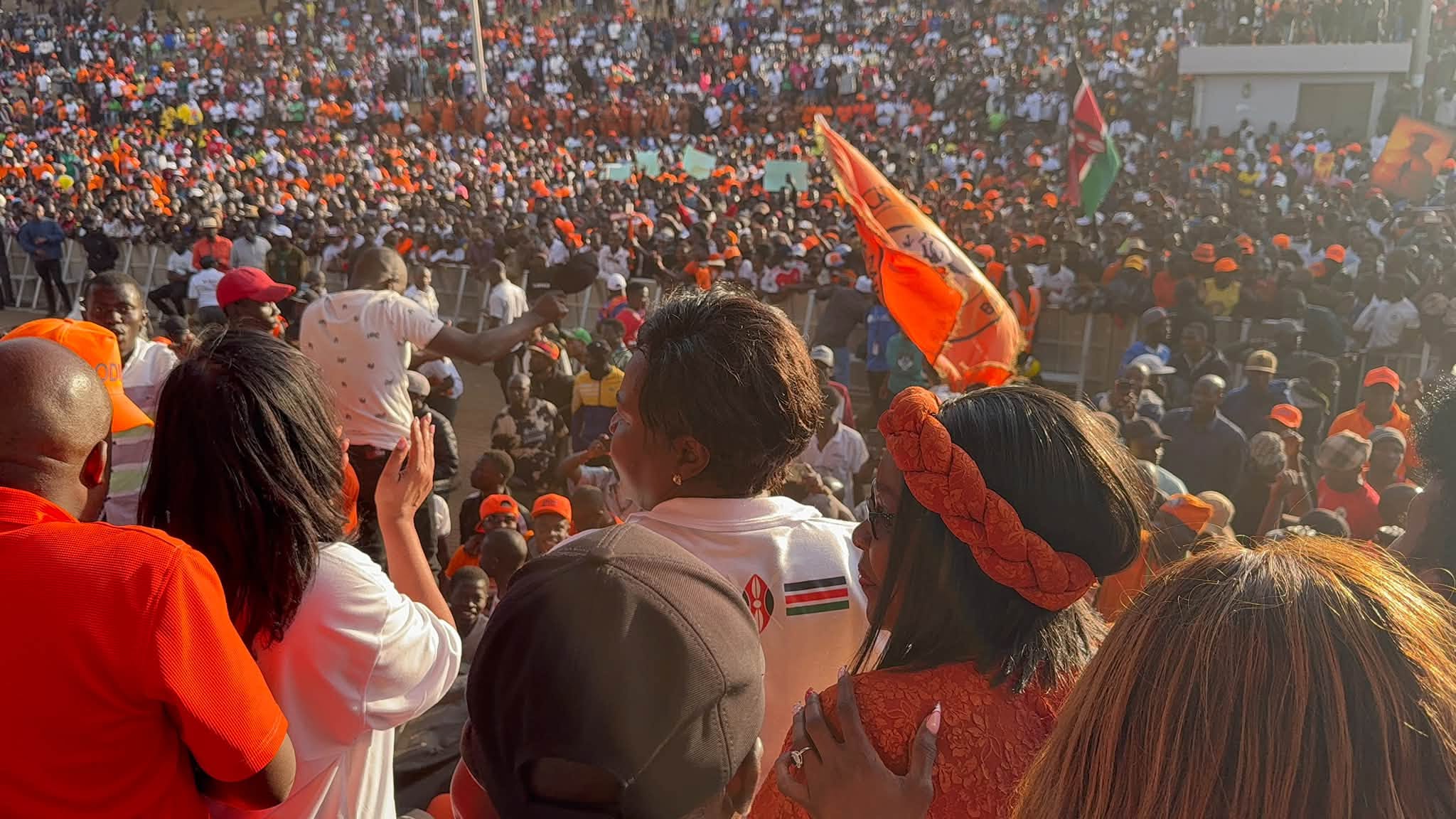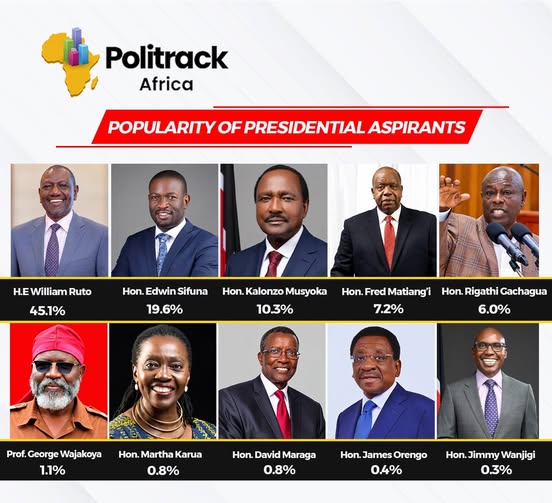

If Kenya’s presidential election were held today, how would the numbers look?
Our snapshot puts William Ruto at 45.1%, Edwin Sifuna at 19.6%, Kalonzo Musyoka at 10.3%, Fred Matiang’i at 7.2%, and Rigathi Gachagua at 6.0%.
I don’t believe in these polls, but this is terrifying to the opposition which has absolutely zero agenda for the country. They are getting dead and deader every minute.
The figures offer a glimpse into the current political landscape—but poll numbers can change as campaigns, alliances and voter preferences evolve.
‘Usiniletee maneno ya mtu mjinga’ – Ruto reacts to journalist over Gachagua’s minerals remarks
President William Ruto, on Thursday, October 1, 2026, during an interview, lost his temper after a journalist questioned him about former Deputy President Rigathi Gachagua’s remarks concerning Kenya’s mineral wealth.
The journalist sought Ruto’s response to Gachagua’s concerns over mineral resources and their exploitation, prompting the president to dismiss the former deputy president’s remarks before shifting the conversation to his administration’s plans for the mining sector.
“Usiniletee maneno ya mtu mjinga kama huyo tafadhali. Tuongee maneno mengine, yule ni mpuuzi sana yule,” Ruto said.
The President then emphasised the importance of minerals to Kenya’s economy, saying his administration had undertaken measures to reform the sector and improve accountability in the management of the country’s natural resources.
“Sikizeni. Kusema ukweli, mambo ya Madini ni mambo ya muhimu sana. Ni nini nimetafanya, ili tuweze kusahihisha ile sekta ya mambo ya madini,” Ruto said.
Gachagua raises concerns over mineral wealth
Ruto’s remarks came days after Gachagua raised concerns over the proposed exploitation of niobium deposits at Mrima Hills in Kwale County.
Speaking in Kansas City, United States, on Saturday, September 19, 2026, Gachagua said he would oppose any agreement that would allow Kenya’s mineral wealth to be exploited without sufficient benefit to Kenyans.
“We will not allow William Ruto to sell our mineral deposits from Mrima Hills,” Gachagua said, adding that niobium was important for electric vehicles and advanced technology.
Gachagua further said he was prepared to pursue legal action over the proposed exploitation of the deposits.
“And even if we have to go to court, we will do so. After this meeting, I will talk to a few lawyers; we start preparing the paperwork because we can’t allow this to happen,” he said.
Gachagua links minerals to Ruto’s US trip
On Sunday, September 20, 2026, Gachagua again addressed the mineral issue while engaging Kenyans in Kansas City.
He said that Ruto’s visit to the United States, where the President was scheduled to attend the 81st United Nations General Assembly, was also intended to advance discussions on Kenya’s critical minerals.
“His real mission in the United States is to come and seal a deal with Americans on how Niobium will be exploited from Kenya,” Gachagua said.
Gachagua also urged Kenyans, particularly residents of Kwale, to demand accountability over the mineral deposits, which he put at a value of about Ksh8.2 trillion.
“What are the leaders in Kwale doing with mineral deposits worth Ksh 8.2 trillion that could turn their county into a haven?” he asked.
Dangote’s Ksh2.2T Lamu refinery now faces its biggest test: What will locals actually gain?
The groundbreaking of the proposed Dangote East Africa Oil Refinery has turned a long-promised investment into a physical project. But for Lamu, the more consequential question is no longer whether the refinery will be built. It is what the people living around it will gain from an investment valued at about Ksh2.2 trillion.
The refinery, expected to process up to 700,000 barrels of crude oil a day, is being positioned as a major regional industrial project.
Its promoters say it will help reduce East Africa’s dependence on imported petroleum products, support industries such as petrochemicals and create more than 50,000 jobs. Regional governments have also been offered a combined 30 per cent stake in the facility.
Those numbers explain why the project matters to Kenya. But they do not, by themselves, answer the question increasingly being asked in Lamu: where does the host community fit into the economic structure of the refinery?
The ownership question
The proposed regional equity arrangement gives governments an identifiable ownership pathway. Kenya has been offered a 10 per cent stake, while other East African governments have expressed interest in the remaining regional allocation.
No comparable direct equity allocation for Lamu’s host community has been publicly announced in the ownership arrangements reported so far. That does not mean residents cannot benefit from the project. It means the distinction between regional government ownership and host-community benefit needs to be made clearly.

Ethiopian Prime Minister Abiy Ahmed, Ugandan President Yoweri Museveni, and President William Ruto hold shovels during the groundbreaking ceremony of the proposed Dangote East African Refinery in Lamu.
For Lamu residents, benefits cannot simply be measured by the number of jobs announced from Nairobi or the value of contracts awarded elsewhere.
Local leaders have already called for Lamu youth to receive priority in employment, business and other opportunities arising from the refinery.
That demand points to a practical test for the project: whether local people will acquire the skills, businesses and economic opportunities needed to participate in the refinery’s supply chain rather than merely watch it develop around them.
The land dispute
The issue is particularly sensitive because construction is beginning while a land dispute remains unresolved.
A total of 133 Chandavai residents have challenged the project in the Malindi Environment and Land Court, arguing that they have occupied and used portions of the disputed land for generations and that their interests have not been adequately recognised or compensated. The court has ordered the status quo on the disputed parcel to be maintained pending further proceedings, with the matter scheduled for October 14.
Dangote, meanwhile, has maintained that the Kenyan government had addressed compensation for the land and has said the court process will not stop the refinery’s broader launch.
That difference in position is important because the success of a project of this scale will depend not only on engineering, financing and crude supply, but also on whether affected communities believe the process has been fair.
The refinery therefore needs a benefits framework that is more concrete than ceremonial promises.
That could include transparent local hiring targets, technical training linked directly to refinery jobs, opportunities for Lamu-based suppliers, access to procurement information, support for small businesses entering the supply chain and clear mechanisms for addressing legitimate land and compensation claims.

President Wiliam Ruto speaking during the groundbreaking of the Dangote East Africa Petroleum Refinery, Mokowe, Lamu County on Wednesday, September 30, 2026.
Ksh2.2 trillion must leave a local economic footprint
The refinery’s greatest promise for Lamu is not simply employment at the plant.
If properly structured, the investment could generate a wider local economy around transport, logistics, accommodation, food supply, engineering, maintenance, construction, housing and other services. It could also create a pipeline of technical skills that remains valuable beyond the construction phase.
But that outcome will not happen automatically.
The experience of Lamu residents will ultimately depend on the rules governing who gets hired, who gets contracts, who receives training, how land disputes are resolved and how local communities participate in decisions affecting them.
The project is also unfolding in an environmentally sensitive part of the coast, adding another layer to the need for transparent planning and community participation. Reuters has noted concerns around environmental impacts and Lamu Old Town, a UNESCO World Heritage site.
For the government, Dangote Group and Lamu County leadership, the challenge now is therefore bigger than breaking ground.
They have to demonstrate that a Ksh2.2 trillion investment can produce a measurable local economic footprint.
The refinery may eventually be judged by its capacity, output and contribution to East Africa’s energy security.
But in Lamu, another measure will matter just as much: whether ordinary residents can point to the project and say, in concrete terms, this investment changed our lives too.
Ruto recalls past mining operations


In his response, Ruto appeared to broaden the discussion beyond the controversy surrounding Mrima Hills and pointed to the need for Kenya to properly document and account for its mineral resources.
He cited his own experience with mining operations in the Mount Kenya region, saying minerals had previously been extracted and sold, leaving behind what he described as an abandoned site without a proper national record of what happened to the resources.
“Mimi mwenyewe, mlima pale tulikuwa na madini, ile ambayo ilichimbulimbiliwa na Best Denim. Tukauza haya madini yakaisha. Yule akafungwa pale, ikabaki sasa ni mahame,” Ruto said.
He questioned what future generations would tell the government if they discovered that mineral resources had existed in Kenya, but there was no proper record of where they went.
“Lakini, we have no trace as a country. Watoto wetu kesho wakituuliza kulikuwa na madini hapa, yalikwenda wapi? Hiyo madini ilipotea wapi?” he posed.
The President said the experience demonstrated the need for stronger systems to monitor mineral extraction and ensure that Kenya derives greater value from its natural resources.
The exchange comes amid renewed debate over Kenya’s critical minerals, including niobium and rare-earth elements, and the government’s plans to attract investment while retaining more value from mining through local processing and value addition.
And President William Ruto is on a mission for Kenya as everybody can see.
Ruto reveals plan to feed Lamu refinery with crude oil
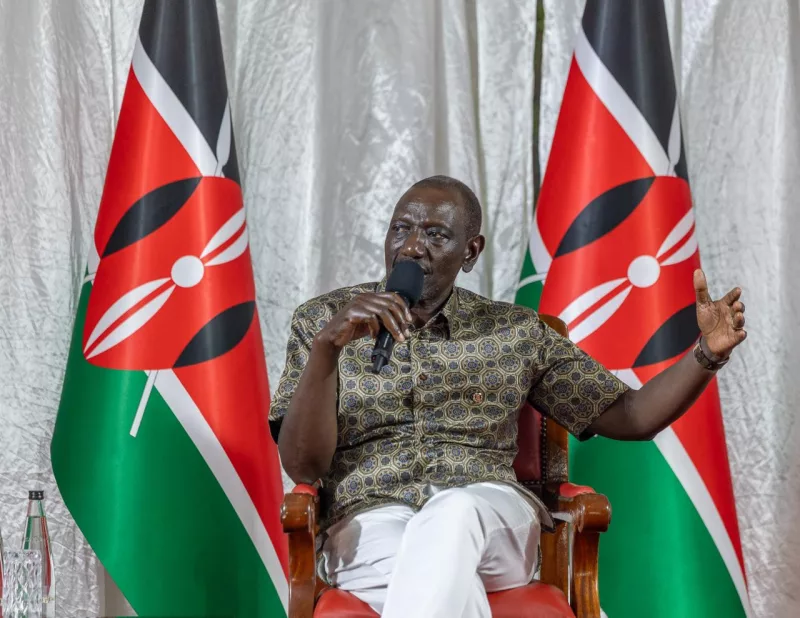
President William Ruto has explained how the planned Lamu refinery will source the crude oil needed to operate the facility, saying Kenya’s production will be supplemented by supplies from other countries.
Ruto said the government had agreed with Nigerian businessman Aliko Dangote to invest in a crude oil pipeline connecting Turkana to Lamu, which will allow Kenya to transport locally produced oil to the refinery.
“We have agreed with Dangote that he will help us, as Kenya, to build a pipeline that will connect Lamu and Turkana so that we can bring the oil from Turkana to Lamu,” Ruto said.
The President said Kenya expects to begin extracting crude oil from Turkana before December, paving the way for its transportation to Lamu.
He said discussions were also ongoing with neighbouring countries, including Sudan, on sourcing crude for the refinery.
Ruto explained that the refinery would not depend solely on Kenyan crude, noting that refineries require different types of crude oil to produce petroleum products.
“A refinery cannot use one type of crude oil. I have been told you need different types of crude oil to refine petroleum products,” he said.
Ruto said even if Kenya supplied its own crude from Turkana, additional oil would still be required from other sources.
He cited Dangote’s refinery in Lekki, Lagos, which sources crude from different parts of the world depending on availability and price.
“Wherever you get crude at a cheaper price, you source it from there and bring it to the refinery,” he said.
Ruto said the same approach would be adopted at the Lamu refinery, with crude expected to come from different parts of the world as well as from East African producers.
He said some of the petroleum products refined in Kenya would be sold locally, while others, including jet fuel, could be exported to international markets depending on demand.
The comments come after the groundbreaking of the planned East African Oil Refinery in Lamu, a Sh2 trillion project with a planned processing capacity of 700,000 barrels of crude oil per day.
The facility is expected to serve markets across East Africa and is scheduled for completion by 2030.
Kenya’s domestic crude production will initially account for only a fraction of the refinery’s planned capacity, making access to international and regional supplies an important part of its sourcing strategy
There are so many desperate politicians in Kenya hoping to jump on the Edwin Sifuna ticket and they don’t care what happens to Sifuna in his presidential ambitions.