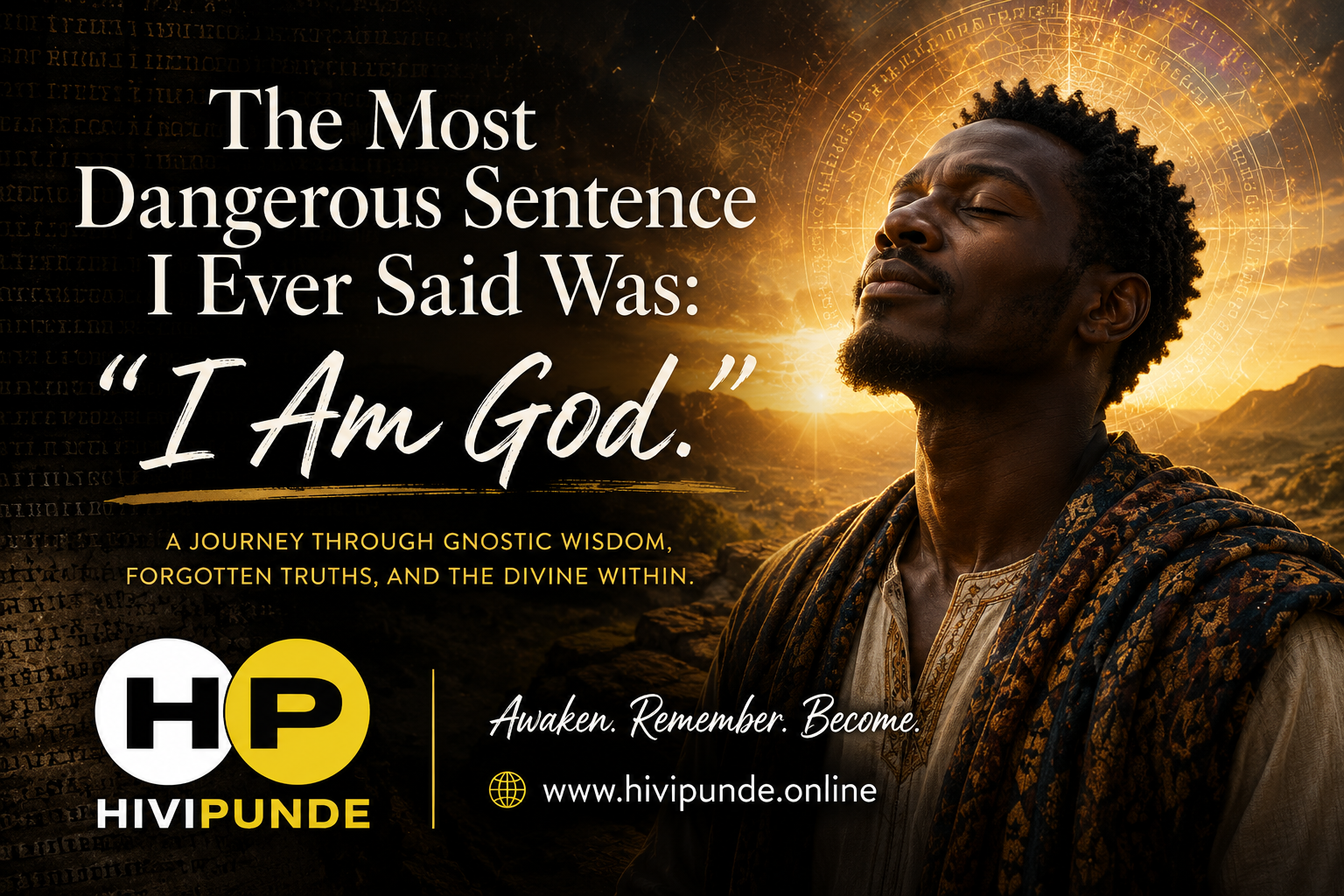

The most dangerous sentence I ever said was, “I am God.”
Not because I believed I was some supreme being standing above everyone else. Not because I was consumed by ego or grandiosity. And certainly not because I wanted anyone to worship me.
In fact, the statement emerged from a place of humility rather than pride. It came from a realization that many mystics, philosophers, and spiritual seekers throughout history have arrived at, often at great personal cost.
For most people, those three words trigger immediate alarm. They sound like blasphemy, the kind of thing that would get a person condemned by religious authorities or dismissed as delusional.
Yet the more I studied the forgotten corners of spiritual history, the more I discovered that the idea was neither new nor unique. It was part of an ancient conversation that has been unfolding for centuries.
One of the texts that first challenged my assumptions was the Gospel of Thomas, discovered among the Nag Hammadi manuscripts in Egypt in 1945.
Unlike the canonical gospels familiar to most Christians, Thomas reads as a collection of sayings and mystical insights. One passage in particular struck me deeply: “The Kingdom is inside of you, and it is outside of you. When you come to know yourselves, then you will become known.”
Those words carried a radically different message from the one many people associate with religion.
The kingdom was not portrayed as a distant reward waiting beyond death. It was described as something already present, something hidden within and around us. The challenge was not to find it somewhere else, but to recognize it.
That idea echoed through the teachings of Valentinus, one of the most influential Christian thinkers of the second century. Valentinus taught that human beings carry within themselves a spark of the divine.
We are not separate from the sacred but expressions of it, fragments of a greater reality that have forgotten their origin. From that perspective, saying “I am God” is not an act of self-exaltation. It is more like a seed remembering that it came from a tree. It is a spark recognizing the fire from which it emerged.
History is filled with men and women who arrived at similar conclusions. The Christian mystic Meister Eckhart spoke of a divine presence within the soul so intimately connected to God that many church authorities viewed his teachings with suspicion.
The Sufi mystic Mansur al-Hallaj declared, “I am the Truth,” and paid for those words with his life. Across traditions, across centuries, the same insight kept resurfacing. The language differed, but the essence remained remarkably consistent: the divine is not as distant as we imagine.
What fascinated me even more was the Gnostic idea that humanity suffers from a kind of spiritual amnesia. According to many Gnostic texts, our greatest problem is not sin but forgetting. We become so absorbed in the material world, so attached to identities, fears, ambitions, and divisions, that we lose sight of our deeper nature. We come to believe we are isolated individuals cut off from one another and from the source of existence itself.
The ancient Gnostics described this condition through myths and symbols. They spoke of the Demiurge, a lesser creator who thrives on ignorance and separation. Whether one interprets these stories literally or metaphorically is beside the point. Their enduring power lies in the insight they offer.
Every time we define ourselves solely by our limitations, every time we see ourselves as disconnected from the rest of creation, we reinforce the illusion of separation.
The Apocryphon of John tells the story of Sophia, whose divine light becomes trapped within the material world. It is a myth, but it feels strangely familiar. Most of us carry a sense that something is missing. We search for meaning, belonging, and purpose. We feel homesick without knowing exactly where home is. Perhaps that longing is the light within us trying to remember itself.
This is why I no longer hear the phrase “I am God” as an expression of arrogance.
To me, it means something entirely different. It means recognizing that the boundary between the human and the divine may not be as absolute as we have been taught. It means understanding that beneath our differences, beneath our identities and labels, there exists a deeper unity.
Ironically, that realization does not inflate the ego; it dissolves it. If the divine exists within me, then it exists within you as well. It exists within every person I encounter. The conclusion is not that I am special. The conclusion is that none of us are separate.
Perhaps that is why such ideas have always been controversial.
Institutions are often built upon authority, hierarchy, and mediation. Mystics tend to bypass those structures and point people inward. They suggest that the journey toward God begins not with obedience to an external system but with self-knowledge. They insist that the kingdom is already here, waiting to be recognized.
I am not claiming certainty. I do not pretend to possess secret knowledge or final answers. The older I get, the more comfortable I become with mystery.
But I have come to believe that the most dangerous ideas are not necessarily the false ones. Sometimes the most dangerous ideas are the ones that invite us to question the assumptions we have inherited.
When I said, “I am God,” I was not claiming divinity for myself alone. I was expressing a possibility that countless seekers before me have explored. That the divine is woven into the fabric of our being, that separation is an illusion, and that the spiritual journey is less about becoming something new than remembering what we have always been.
Maybe the real heresy is not believing we are connected to God.
Maybe the real heresy is forgetting.