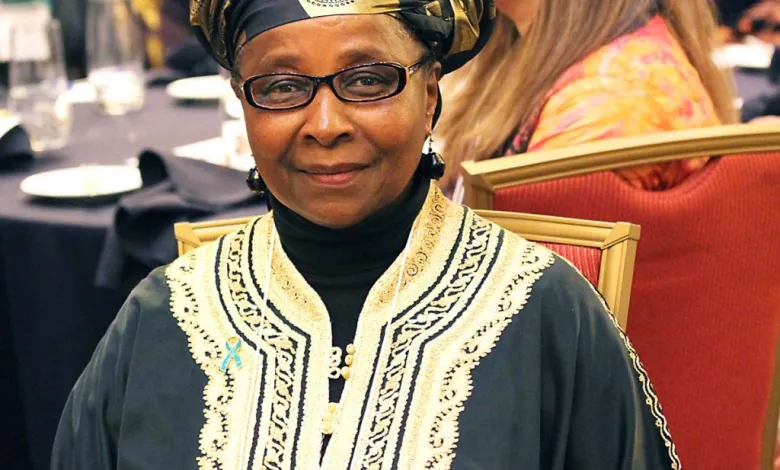


MICERE Githae MUGO: Our Struggle is One
“Kenyan women have refused to be dehumanized. We are fighting everyday for the right to live, the right to eat, the right to nurture ourselves and our society”
Micere Mugo exiled Kenyan poet and writer told a solidarity forum in Toronto at the end of April 1991.
Micere Mugo’s trip to Canada proved to be the highlight of the 1991 calendar of the Kenya Human Rights Organization in Canada.
During the two day stay in Toronto the exiled political activist participated in three events.
On April 26, 1991, she was one of three panelists in a forum “Sisters in The Struggle” which took place at the Trinity St. Paul Church.
Nada el Yasir of the Palestinian Women’s Association and Dinora Aldana, a member of the COMADRES Salvadorean Women’s group joined their hands and voices with Micere to share the experience of women in Latin America, Africa and the Middle East struggling against imperialism in its many forms.
The audience listened attentively to Dinora Aldana as she recounted the horror stories of death squad activities in El Salvador.
Dinora ended her presentation with these moving words.
“We don’t see these things as something which happens simply because men are bad or that their conduct is an isolated incident. All this is a consequence of a system which gives less value to that which is feminine and which discriminates against us for the simple reason of not being male”
“I am speaking of the capitalist and patriarchal systems in which we have all been brought up and educated in and in which the degeneration based on gender only favours capitalism because this takes away a base for popular organizations.”
Speaking at the same event Nada el Yassir a Palestinian human rights activist declared that the Palestinian women participation in the intifada, in a historical analysis of the struggle for self-determination of the Palestinian people.
“Palestinian women suffer a dual oppression” Nada observed. “Not only do they suffer from gender oppression, but they suffer from national oppression as well.”
“The struggle of the Palestinian woman is to her a dual struggle; firstly, primarily, a struggle for the liberation of her people as a whole, and then the struggle for her own emancipation.
The participation of Palestinian women in the struggle has been vital. Without her strength, without her courage, without her holding the family together and instilling and maintaining in her children the very important sense of identity, the Palestinian struggle wouldn’t be where it is today.”
The last speaker on the panel was Prof. Micere Mugo, who gave a detailed account of the oppression of women in Kenya within the context of active involvement of women in the historical battles to free the nation from colonial rule, to the present-day battles against the fascist rule of Moi and Kanu at the time.
“In our history the women have been at the forefront of all battles. During the Mau Mau war of national resistance, they were there trafficking weapons, trafficking the soldiers and fighting alongside the men.”
Micere reminded the audience that it was not surprising that the deputy commander of the Kenya Land and Freedom Army was a woman, Field Marshall Muthoni wa Kirima.
Venturing further into the history of resistance by Kenyan women, Micere mentioned the heroic contributions of Kenya anti-colonial freedom fighters like Me Katilili and Mary Nyanjiru.

Mekatilili organized one of the first known guerrilla campaigns in Kenya against British Colonialism.
Micere observed that Kenyan women have come a long way using every opportunity available to them to fight against oppression and refusing to be acted upon as objects of history.
“Today they are involved in the struggles for popular democracy, they are fighting against the human rights abuses of the Moi government, they are within the women’s movement, they are in the churches and in schools and colleges fighting for their rights and for the democratic rights of the whole society.’’
“The women who yesterday were made to dance for politicians as entertainers are today boycotting those dances. They are networking amongst themselves, starting projects for self help and for economic self-determination.”
“We live in a society where the rich have their way and the poor are being asked to accept this condition, to agree to be acted upon, we are dealing with uncivilized leadership, those who excel in dehumanizing their own population.
Those who suffer the most are the working class, people from the peasantry and women who are at the bottom.
That is the condition in our country and when we speak of women we speak about one of those groups of people in human society who are sat upon, who are denied a voice, who are expected to walk around and not be seen.
By keeping majority of women illiterate, neo-colonialism ensures that these women are kept as servants of society without ever having any prospects of self-determination.
Right from birth girls are treated as commodities. Female children are seen as of less value and many women are divorced because they cannot produce a boy. All these lead to barriers, self-censorship and myths that ask women to sit there and let history act upon them. We have refused that condition.
Micere Githae Mugo is one of Kenya’s most distinguished scholars. A poet of international repute, she also co wrote “The Trial of Dedan Kimathi” which was Kenya’s official entry at the second FESTAC festival in Lagos, Nigeria.
In the 1970’s and early 80’s, she together with Ngugi wa Thiong’o, Mumbi wa Maina, Willy Mutunga, Shadrack Gutto and others represented a new breed of Kenyan academic foot soldiers for the country.
Here was a group of brilliant lawyers, professors, writers, accountants and accomplished professionals who had turned their backs on the arrogant aloof-ness of their colleagues to reach to the grassroots and demystify formal education and transform it from being merely a personal escape route from rural poverty into weapons of struggle for social justice in Kenya.