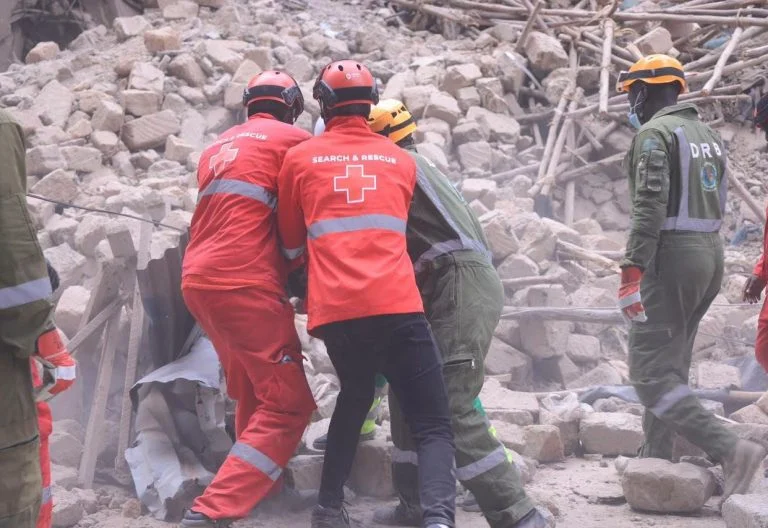

The country is in the grips of a horrific huge building collapse in Eastleigh and many Kenyans are asking questions about how these buildings and the construction industry is managed by the Kenya government and the county authorities in a place like Nairobi City.
The collapse of a multi-storey building in Eastleigh has renewed scrutiny of Nairobi’s construction industry, where questions over building approvals, professional supervision and regulatory enforcement have persisted through successive structural disasters.
Nairobi County said the ground floor was occupied, while authorities reported fears that people were trapped beneath the rubble. The cause had not been established in initial reports.
Governor Johnson Sakaja said the priority was rescuing people who might still be alive.
“Right now, it’s for us to save lives, and so we’re clearing the debris,” describing the deployment of excavators and breakers to remove large pieces of rubble.
The collapse has placed renewed attention on whether approved building plans, construction standards and professional oversight are being followed consistently across the capital.

Nairobi County governor Johnson Sakaja said the building did not comply with construction guidelines and vowed that legal action would be taken against its owner. That statement raises questions about the project’s compliance history, but the specific violations and their relationship to the structural failure require documentary and engineering verification.
Investigators need to establish whether the foundations, structural design, concrete, reinforcement steel and construction sequence met approved specifications. They should also examine inspection records, the qualifications of the professionals responsible and whether the occupied ground floor had the necessary safety clearances.
How unsafe are buildings?
The Architectural Association of Kenya’s Status of the Built Environment Report 2025 says approximately 80 per cent of construction activity occurs without registered professionals, citing the National Building Inspectorate.
The same report states that 87 per cent of 396 developments audited in 2025 failed to comply with building standards or lacked the required approvals. It also records 20,649 developments inspected in 2024, compared with 396 in 2025.
These figures point to concerns about professional involvement, regulatory compliance and inspection capacity. However, the 87 per cent figure applies to the developments audited, not every building in Nairobi.

Debris of the collapsed building under construction in Nairobi’s South C area on Friday, January 2, 2026.
The National Construction Authority (NCA) oversees construction-sector compliance, while the Engineers Board of Kenya regulates professional engineers and engineering services. Nairobi County is responsible for development control within its jurisdiction. Establishing responsibility for the Eastleigh collapse will require scrutiny of records held by these bodies.

Engineers Board of Kenya Registrar/CEO Eng. Margaret Ogai.
Construction quality and accountability
The Eastleigh incident follows the January 2026 South C collapse, where the National Construction Authority confirmed that a formal inquiry would examine the circumstances of the disaster in collaboration with the Engineers Board of Kenya, Nairobi County and other agencies.
As huge buildings are collapsing in Nairobi, President William Ruto is putting up a building construction show across the country with incredible sucess.
Fireworks as Ruto commissions Sh5.3bn Eldoret Pioneer estate, hands over keys to 2,157 homeowners
The Sh5.3 billion estate is part of the government’s Affordable Housing Programme, which seeks to expand access to homeownership
President William Ruto has handed over keys to 2,157 homeowners at the Pioneer Affordable Housing Project in Eldoret City, Uasin Gishu county.
The Sh5.3 billion estate is part of the government’s Affordable Housing Programme, which seeks to expand access to homeownership while creating jobs in the construction sector.
The development features 104 shops, a kindergarten, playgrounds, green open spaces, a clubhouse and a swimming pool.
It will also include a junior school, two basketball courts and a football pitch, facilities intended to support a residential community where families can live, work and access recreational services.
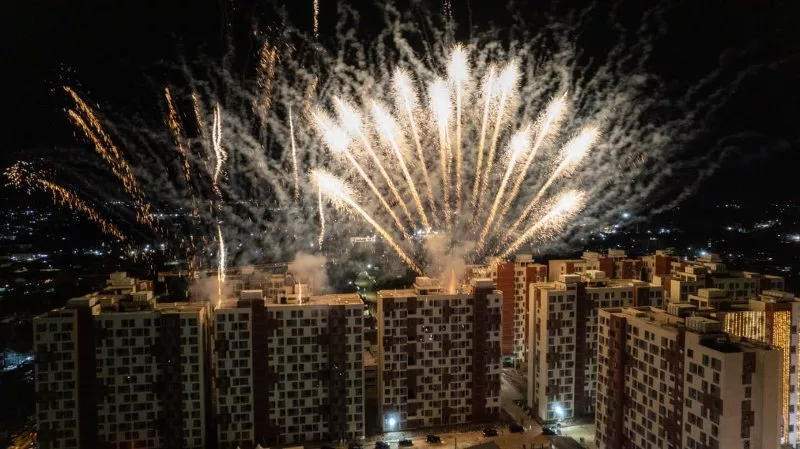
Fireworks during the commissioning of the Pioneer Affordable Housing Project in Eldoret city, Uasin Gishu county on October 18, 2026
Ruto said the housing programme had also incorporated the creative economy by engaging local artists, including painters, to beautify buildings.
The initiative, he said, creates employment opportunities for artists while integrating art into public infrastructure.
The Pioneer project adds to the government’s affordable housing developments aimed at addressing the country’s housing deficit and providing more Kenyans with access to decent homes.
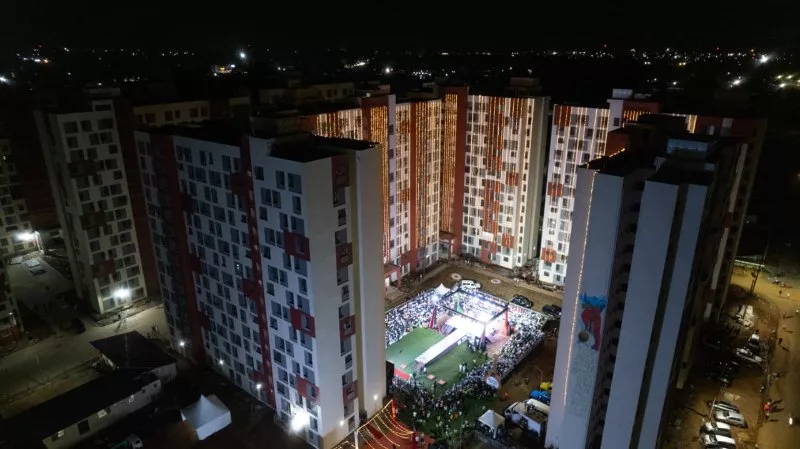
The Pioneer Affordable Housing Project in Eldoret city, Uasin Gishu county on October 18, 2026/PCS

Beneficiaries during the commissioning of the Pioneer Affordable Housing Project in Eldoret city, Uasin Gishu county on October 18, 2026


Sometimes Kenyans look at this work going on and are amazed that they have such good constructions workers and designers and they are just doing their job. No buildings are collapsing in the massive affordable housing program going on all over the country. What they have achieved in just two years is astonishing.
Kenyans doing this building works from the ground are going to be national heroes for generations and this is just the beginning of what they are going to do for their country. Keep it going please.
I know something about building houses in Kenya. My mother, the famous Alice as we called her came to Mombasa after I got a job there at the Mombasa Polytechnic and I just found her sitting at the office when I came to work.
It was funny and we just hang out for a few days and she tells me I have to buy mabati in Mombasa to build a new house for her at home. I tell her we can buy the mabati close to home. No, she said and she wanted it done straight away.
We had to buy the mabati in Mombasa and take them home by railway and we actually built a very good house.
Now the whole place is part of Bondo Municipality which is growing into a city by itself and my family now have to go in that journey which is great.
Adongo Ogony is a Human Rights Activist and a Writer who lives in Toronto, Canada