
Kenyan politics has always been shaped by powerful personalities, compelling ideas, and fierce contests for leadership.
Nowhere is this more evident than within the Luo community, whose leaders have played some of the most consequential roles in the country’s political, social, and economic development over the last two centuries.
Mention Luo leadership today, and most Kenyans immediately think of Jaramogi Oginga Odinga, Tom Mboya, or Raila Odinga.
Yet the story of Luo leadership is much older and far richer than the political narratives that dominate modern discourse.
If historians were tasked with ranking Luo leaders by their long-term influence over the past 200 years, the list would likely include:
- Ramogi Ajwang – Foundational patriarch
- Chief Odera Akang’o – Education and social reform pioneer
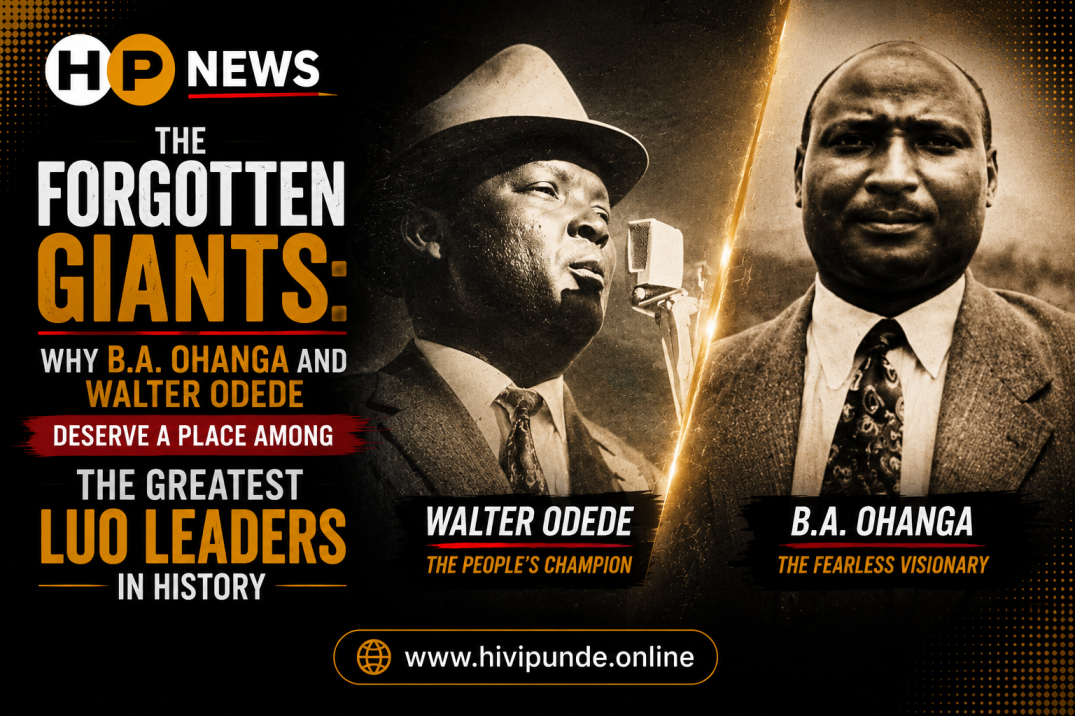
- B.A. Ohanga – First African cabinet minister in colonial Kenya
- Walter Odede – Acting President of the Kenya African Union (KAU)
- Jaramogi Oginga Odinga – Nationalist and opposition icon
- Tom Mboya – Architect of modern Kenya
- Raila Odinga – Leader of the reform movement and former Prime Minister
- James Orengo – Constitutional reform champion
The fascinating reality is that two of these names, B.A. Ohanga and Walter Odede, have largely disappeared from popular memory despite being among the most influential Luo leaders of their era.
Ramogi Ajwang: The Foundation of a People
Any discussion of Luo leadership begins with Ramogi Ajwang, the legendary patriarch believed to have led Luo migrations into present-day Kenya around the late 18th and early 19th centuries.
While historians continue to debate exact dates, Ramogi occupies a position similar to that of a founding father in Luo oral tradition. He symbolizes the establishment of Luo settlements around the Winam Gulf and laid the foundation for the social, cultural, and political structures that would shape generations to come.
Without Ramogi, there would be no collective Luo identity as it is known today.
Chief Odera Akang’o: The Man Who Made Education a Luo Obsession
If Ramogi gave the Luo a homeland, Chief Odera Akang’o gave them a future.
Born around 1880, Odera Akang’o served as chief in Gem from the early 1900s until the 1940s. During his tenure, he became one of the most influential African administrators in colonial Kenya.
At a time when many communities viewed formal education with suspicion, Odera aggressively promoted schooling. He encouraged families to send children to school, introduced modern farming techniques, emphasized hygiene, and championed social discipline.
Many historians credit him with creating the educational culture that later enabled the Luo community to produce disproportionate numbers of teachers, civil servants, lawyers, doctors, and political leaders.
The educational achievements associated with Nyanza today owe much to Odera Akang’o’s vision more than a century ago.
B.A. Ohanga: The Forgotten Powerhouse of the 1950s
Few Kenyans today recognize the name B.A. Ohanga, yet in the early 1950s he was arguably the most powerful Luo politician in the country.
Born in 1906, Benjamin Alfred Ohanga rose rapidly through colonial politics during a period when opportunities for Africans remained severely restricted.
In 1954, Governor Evelyn Baring appointed Ohanga to the multiracial Council of Ministers, making him the first African cabinet minister in Kenya’s history.
This was a monumental achievement.
Remember the context. Kenya was still a British colony. The Mau Mau Emergency was underway. African political participation remained tightly controlled. Yet Ohanga found himself at the center of decision-making within government.
At the time, he enjoyed greater formal political power than many nationalist leaders who would later become household names.
His influence extended beyond Luo Nyanza. He was viewed by the colonial administration as one of the most important African leaders in Kenya.
Yet history has not been kind to him.
As nationalist politics intensified in the late 1950s, many Africans increasingly viewed leaders who cooperated with colonial structures with suspicion. The political tide shifted toward more militant anti-colonial voices, and Ohanga’s legacy gradually faded from public memory.
Walter Odede: The Man Who Temporarily Led Kenya’s Independence Movement
Walter Odede occupies another overlooked chapter in Kenya’s political history.
A respected trade unionist and nationalist, Odede emerged as a major political figure during the struggle for independence.
Following the arrest and detention of Jomo Kenyatta during the Mau Mau Emergency, leadership of the Kenya African Union (KAU) became increasingly fragmented.
Odede rose through the ranks and eventually served as Acting President of KAU during a critical period when the nationalist movement was under immense pressure.
This was no ceremonial role.
KAU was the principal vehicle through which Africans demanded political rights and self-government. Leading the organization, even temporarily, meant helping sustain the struggle for independence at one of its most difficult moments.
Yet like Ohanga, Odede would later be overshadowed by larger political personalities whose movements ultimately dominated post-independence politics.
Jaramogi Oginga Odinga: The Man Who Won the Leadership Battle
If B.A. Ohanga represented establishment politics and Walter Odede represented organizational nationalism, Jaramogi Oginga Odinga represented mass political mobilization.
Born in 1911, Jaramogi became the dominant Luo political figure during the late 1950s and early 1960s.
His support for African nationalism, his insistence that Kenyatta be released before independence negotiations proceeded, and his ability to mobilize grassroots support transformed him into a political giant.
Most importantly, Jaramogi won the battle for Luo political leadership.
That victory reshaped history.
As Luo politics increasingly aligned behind Jaramogi’s vision, earlier leaders such as Ohanga and Odede gradually slipped into the shadows. The winners often write political memory, and Jaramogi’s movement became the defining force in Luo politics for decades.
Tom Mboya: The Architect of Modern Kenya
If Jaramogi was the movement builder, Tom Mboya was the nation builder.
Born in 1930, Mboya rose from trade union activism to become one of Africa’s most admired young politicians.
His leadership of the famous airlift programs helped hundreds of East African students access higher education in the United States.
As Minister for Economic Planning and Development after independence, Mboya played a central role in designing Kenya’s modernization strategy.
Many of the economic frameworks that guided post-independence Kenya bear his imprint.
His assassination in July 1969 remains one of the most consequential events in Kenyan political history.
Raila Odinga: The Face of the Reform Era
Few politicians in modern Africa have shaped democratic reform as profoundly as Raila Odinga.
For more than four decades, Raila has remained at the center of Kenya’s political evolution.
From detention during the Moi era to the struggle for multiparty democracy, from the 2007 post-election crisis to the constitutional reforms that culminated in the 2010 Constitution, Raila’s influence is undeniable.
Whether one supports him or opposes him politically, his role in expanding democratic space in Kenya has secured his place among the country’s most consequential leaders.
James Orengo: The Constitutional Warrior
Among contemporary Luo leaders, few possess the reform credentials of James Orengo. I will never agree with his politics but I respect the work he has done for the country, both under Jaramogi and while with Raila Odinga.
Beginning with student activism in the 1970s, through detention during the one-party era and later constitutional reform campaigns, Orengo has consistently positioned himself at the forefront of democratic struggles.
His legal and political contributions to the making of the 2010 Constitution have cemented his reputation as one of Kenya’s foremost constitutional reform champions.
What Today’s Politicians Can Learn
The story of Luo leadership reveals an important lesson for modern Kenyan politics.
History is rarely as simple as popular memory suggests.
Today’s political debates often revolve around a handful of dominant personalities. Yet every era produces influential figures whose contributions become forgotten because they lose political battles, belong to defeated factions, or simply fail to control the narrative.
B.A. Ohanga and Walter Odede remind us that influence and remembrance are not always the same thing.
In today’s Kenya, where political branding often matters as much as political achievement, their stories offer a cautionary lesson. Leaders who dominate headlines today may not necessarily dominate history tomorrow.
Two hundred years from now, historians will not simply ask who shouted the loudest. They will ask who built institutions, transformed communities, expanded opportunity, and altered the course of the nation.
By that standard, the forgotten giants of Luo history deserve another look.
As Kenya approaches the 2027 political contest, perhaps it is time to remember that leadership is bigger than elections, bigger than parties, and bigger than personalities. The true measure of a leader is the legacy they leave behind long after the political rallies have ended.