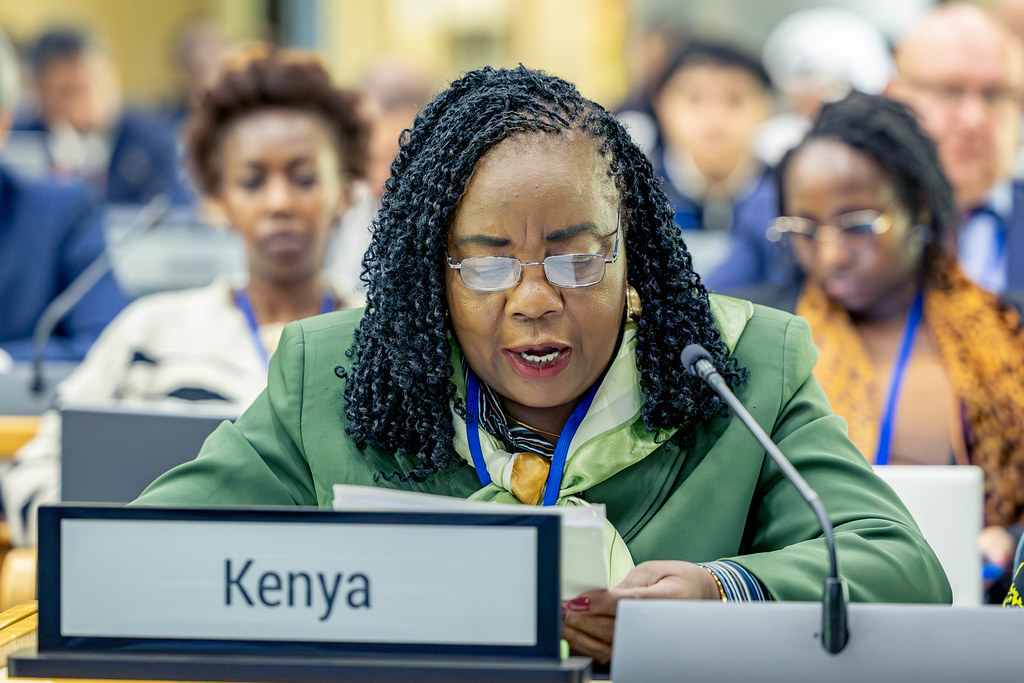

Ida Odinga pushes for tech transfer at UNEP meeting
Kenya’s Ambassador to the United Nations Environment Programme, Ida Odinga, has called for urgent global action to ensure developing countries are not left behind in environmental decision-making.
Speaking at the 173rd session of the United Nations Environment Programme (UNEP) Committee of Permanent Representatives in Nairobi, Odinga urged that science-based policies must be backed by real technology transfer and stronger data systems in developing nations.
Delivering remarks on behalf of the G77 + China, she emphasized the need to strengthen how countries manage and use environmental information to respond effectively to climate and ecological challenges.
“Science-based decision-making must be accompanied by real tech transfer to developing countries and strengthening statistical capacity to manage environmental information,” she said.Odinga noted that while scientific guidance remains central to global environmental governance, practical support is essential to enable implementation on the ground.
Ida Odinga’s remarks come as member states gather in Nairobi for key environmental discussions, including sessions of the UN-Habitat Executive Board taking place between April 21 and 22, 2026.
The meetings are set to review the 2026–2029 Strategic Plan, alongside financial, administrative and budgetary priorities for 2027.The UNEP Committee of Permanent Representatives is a key oversight body that brings together member states to guide global environmental policy and review progress on major initiatives.
Kenyan politicians’ idea of fighting against climate change is planting trees here and there once in a while and never mind how many grown trees the same politicians are cutting down to make big money.
The new Kenya Ambassador to UNEP Ida Odinga brings in a key element that is completely lacking in our climate change battles in Kenya and the rest of Africa.
In terms of climate change we need to maximize the use of Solar Energy in a country like Kenya to cut down on our dependence on fossil fuels for everything.
For the love of God, the Equator passes right through Kenya. In fact, in one of my hometowns and beloved Maseno when I go there, I never forget to visit the site where it says “The Equator Passes Here”. It is beyond lovely to know you are there.


That means of all the countries in the world including China where Solar Energy and the technology to harness it is everywhere, it is only us in Africa which has the sun all year round.
We do not have winters and no snow and we could be turning a country like Kenya into a Solar Energy superpower instead of depending on oil producing countries for our very much needed fuel for industrial growth and domestic use.


In a world today that is terrified with the increasing consequences of climate change around the globe, Solar Energy is one of the greatest gifts that world can have to replace fossil fuel where possible.
Solar Energy comes from the sun and no country can invest to create their own sun. Many countries producing a lot of Solar Energy today like here in Canada have the sun shining from May to August each year. That is four months for the whole year.
In Kenya and Africa as a whole we have the sun shining 12 hours a day for twelve months. In real terms that mighty little sun, up there for which we pay nothing could be one of the biggest assets countries like Kenya and our whole continent have and we are doing nothing with it in terms of building real technologies for Solar Energy.
UNEP Ambassador Ida Odinga needs to take her message to our national government as well as the counties that our country has everything we need to use Solar Energy to improve the lives of millions of Kenyans and to develop the economy and employ thousands of young people in a real effort to address climate change.
If we do that the country is going to get support from international agencies trying to bring climate change under control because it threatens everybody’s life. Then those international agencies can work with community organizations and groups on practical projects to fight climate change in Kenya.