

The United Nations General Assembly has voted to recognise the enslavement of Africans during the transatlantic slave trade as “the gravest crime against humanity,” marking a historic step that advocates say could open the door to global healing and justice.
The resolution, proposed by Ghana, calls on UN member states to acknowledge the slave trade’s enduring impact and to consider issuing formal apologies and contributing to a reparations fund. While the resolution does not specify any financial commitments, it urges nations to take moral responsibility for the atrocities committed over centuries.
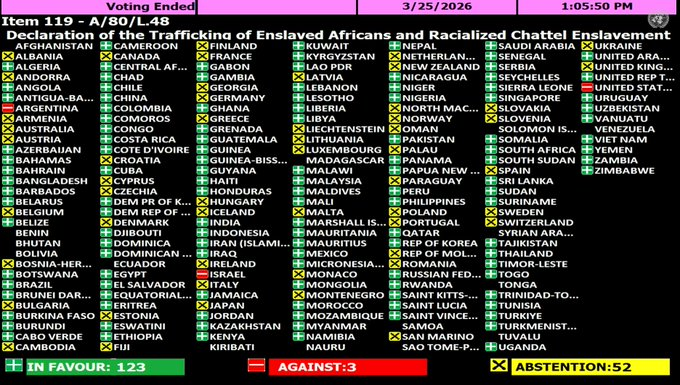
The measure passed with 123 votes in favour, three against, and 52 abstentions. The United States, Israel, and Argentina voted against the resolution, while the United Kingdom and European Union member states abstained. Although General Assembly resolutions are not legally binding, they carry significant symbolic and political weight, reflecting the collective conscience of the international community.
“Let it be recorded that when history beckoned, we did what was right for the memory of the millions who suffered the indignity of the slave trade and those who continue to suffer racial discrimination,” Ghana’s President John Mahama told delegates before the vote. “The adoption of this resolution serves as a safeguard against forgetting. It also challenges the enduring scars of slavery.”
Ghana’s Foreign Minister, Samuel Okudzeto Ablakwa, speaking earlier to the BBC’s Newsday programme, emphasised that the call for reparations is not about financial gain for governments but about justice and restoration. “We are demanding compensation – and let us be clear, African leaders are not asking for money for themselves. We want justice for the victims and causes to be supported, educational and endowment funds, skills training funds,” he said.
The resolution comes amid growing global momentum for reparatory justice. The African Union designated 2025 as the “Year of Reparatory Justice,” and Commonwealth leaders have jointly called for dialogue on reparations and historical accountability.
While some Western nations, including the UK, have long resisted calls for reparations, arguing that current institutions cannot be held responsible for historical wrongs, advocates say the UN’s recognition marks a turning point. They hope it will strengthen efforts to address the legacies of slavery, including systemic racism and economic inequality, that persist across the world today.